
Major laggards among Sensex constituents included Bharti Airtel, Hindustan Unilever, Tata Steel and ITC. Power Grid, UltraTech Cement, NTPC and Titan emerged as winners.

Growth in India's currency in circulation (CiC) has reached a five-year high, primarily due to deposits under the Foreign Currency Non-Resident (Bank), or FCNR(B), scheme, leading to a robust increase in reserve money, according to the Reserve Bank of India's (RBI) 'State of the Economy' report.
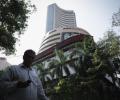
Indian benchmark indices, Sensex and Nifty, closed almost flat in choppy trade as investors remained cautious due to ongoing uncertainty in West Asia, relentless foreign fund outflows, and anticipation of the RBI's monetary policy decision.

The RBI cut the rate several times last year to reduce it by 125 basis points to the current 6.75 percent.

The central bank kept cash reserve ratio unchanged at 4 per cent.

These are the highlights of the seventh bi-monthly monetary policy statement for 2019-20 by the RBI amid COVID-19 pandemic:

Indian stock markets closed lower, with the Sensex falling 429 points, after the Reserve Bank of India raised its benchmark interest rate for the first time in nearly four years, coupled with rising crude oil prices and persistent foreign fund outflows.
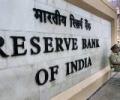
The Reserve Bank of India on Friday said it will come out with its annual monetary policy for the next fiscal on April 20, amid expectations that the central bank will hike interest rates to tame the rising inflation

The Reserve Bank of India (RBI) is widely expected to keep its benchmark repo rate unchanged in the August monetary policy review, with economists citing elevated inflation risks and the pending closure of the FCNR(B) deposit scheme as key factors. Most anticipate a 'Neutral' policy stance but with a hawkish tone due to geopolitical tensions, high crude oil prices, and an uneven monsoon.

The inflation target of the RBI would be reviewed once every five years.

The International Monetary Fund (IMF) has said the tightening of monetary policy by India is an 'appropriate' step, as the country is faced with high inflation and needs to consolidate the fiscal measures initiated during the slowdown.

Reducing policy rates is not enough. The key is to ensure banks lend to credit-constrained borrowers.

The International Monetary Fund (IMF) has increased India's growth forecast to 7 per cent for 2026-27, up from 6.4 per cent, attributing this robust outlook to resilient domestic demand and strong services activity, positioning India as one of the fastest-growing major economies.

'A balance had to be struck between the economic cost of taking action at this point against the need not to fall behind the curve in controlling inflation and anchoring inflation expectations.'

The apex bank hiked its repo, reverse repo (overnight lending and borrowing rates) to 5.25 per cent and 3.75 per cent, respectively, while the cash reserve ratio, or the portion of deposits banks park with RBI, to 6 per cent in line with analysts' expectations.

The Lok Sabha elections in 2024 are not a consideration when it comes to monetary policymaking, said Reserve Bank of India governor Shaktikanta Das to underscore the central bank's commitment to controlling inflation. "It's not possible for me to comment what we do in the next MPC (Monetary Policy Committee), but one thing I can tell and I would like to make it very clear-that the fact of elections coming up in 2024 is not a factor at all so far as monetary policymaking is concerned. "Monetary policymaking is for checking (and) controlling inflation," Das said at the Business Standard, BFSI Insight Summit.

Reliance Industries Ltd (RIL) has successfully raised a total of Rs 25,000 crore through domestic bond issues in September, including a recent Rs 13,000 crore 10-year bond at 7.90 per cent, as it prioritises funding certainty amidst expectations of a possible RBI rate hike and rising borrowing costs.

Amid expectations that the Reserve Bank may keep its monetary stance unchanged, the central bank will come out with its second quarter review of the credit policy for the current fiscal on October 27.

This time the all-powerful interest-rate setting panel, whose constitution was notified by the government on Thursday, will take call on interest rate. But that's not the only change. The Reserve Bank of India has also decided to change the timing of announcement of its policy review, due next Tuesday, to mid-afternoon.

While the RBI, in the recent past, appeared keen to move to an inflation-targeting framework, industry and academia remain divided on this issue.

The Indian stock market experienced a significant downturn, with the Sensex crashing over 1,000 points and the Nifty hitting a fresh 52-week low, driven by sustained selling from foreign institutional investors, the RBI's monetary policy tightening, and elevated Brent crude prices.

Indian benchmark stock indices, Sensex and Nifty, closed lower due to profit-taking, a spike in wholesale price-based inflation, and firm crude oil prices, despite some support from easing intraday crude oil prices and rupee appreciation.

S&P Global Ratings has affirmed India's sovereign credit rating at 'BBB' with a stable outlook, citing the country's dynamic and fast-growing economy, strong external balance sheet, and stable institutions that ensure policy predictability.

The Reserve Bank has reduced interest rate by 150 bps since January 2015.

Indian benchmark indices, Sensex and Nifty, closed marginally lower due to elevated crude oil prices, fresh US-Iran tensions, and expectations of a tighter monetary policy from the US Federal Reserve, despite strong domestic GDP growth.

The highlights of the RBI's fourth monetary policy review of fiscal year 2022-23 announced by Governor Shaktikanta Das.

Reserve Bank of India (RBI) Governor Sanjay Malhotra stated that surplus liquidity in the banking system is expected to drain within the current financial year, utilising tools like currency leakage, sell-buy swaps, open market operations (OMOs), and variable rate operations.

From the Sensex pack, Power Grid, Mahindra & Mahindra, JSW Steel, HCL Technologies, Sun Pharma, Nestle, IndusInd Bank, Reliance Industries, Bharti Airtel and ITC were the major laggards. Tech Mahindra, Wipro, Bajaj Finance, State Bank of India, Bajaj Finserv, Axis Bank, Titan and ICICI Bank were among the major gainers.

Patra, as executive director of the central bank, was the principal advisor to the Monetary Policy Department since July 2012.

Gold prices in India extended their losing streak, falling by Rs 1,500 to Rs 1,60,900 per 10 grams, influenced by hawkish remarks from Federal Reserve Chair Kevin Warsh and rising oil prices, which have increased expectations of an interest rate hike.

Members of the Reserve Bank of India's (RBI) Monetary Policy Committee (MPC) have indicated that interest rate hikes may be necessary sooner rather than later, as headline inflation is projected to rise from its current benign levels in the coming months, according to the minutes of the August review.

The Reserve Bank of India has marginally increased its GDP forecast for the current fiscal to 6.7 per cent while slightly lowering the inflation projection to 5 per cent. The central bank noted that while domestic economic activity shows resilience, global turbulence, particularly re-escalating conflicts and volatile oil prices, continues to pose risks to the inflation outlook.

Inflation to peak in the current quarter within tolerance band, moderating in the second half of next fiscal, says central bank.

Analysts predict that the Reserve Bank of India's interest rate decision, the evolving situation in West Asia involving the US-Iran conflict, and crude oil prices will be the primary factors influencing investor sentiment in the Indian stock market this week.

India's wholesale price index (WPI) inflation marginally eased to 9.78 per cent in July 2026, down from 9.87 per cent in June, primarily due to a cooling in the prices of fuel, power, and food items, marking the first month-on-month drop under the new 2022-23 base year.

Indian benchmark indices Sensex and Nifty saw a significant rebound in early trade, driven by softer-than-expected US inflation data which has reinforced expectations of a less aggressive monetary policy stance from the Federal Reserve, providing relief to global risk assets.

Former Reserve Bank of India governor Yaga Venugopal Reddy said he would have preferred a tighter monetary policy as managing inflation and inflationary expectations were crucial to keep the economy growing.

RBI Governor Sanjay Malhotra announced plans to launch long-lasting polymer currency notes by the next financial year. He also discussed the central bank's data-dependent approach to interest rates, its focus on aligning inflation with the 4 per cent target, and the orderly trajectory of the rupee amidst geopolitical tensions.

The Indian stock market is poised for a volatile week, influenced by the Reserve Bank of India's monetary policy decision, crucial global macroeconomic data, and the escalating geopolitical tensions in West Asia, according to market analysts.

Retail inflation was at a 25-month low of 8.1 per cent in February.
